












Introduction
Running a growing business is exciting, but it also comes with massive organizational hurdles. As companies expand, keeping track of leads, sales inquiries, and customer interactions becomes increasingly complex. Enter CRM Solutions—powerful integrated software suites designed to bring all core customer relationship processes under one roof.
Whether you run a small local shop or a fast-scaling retail brand, managing buyers using isolated spreadsheets or disconnected legacy software causes frustrating bottlenecks. In this comprehensive guide, we will explore everything you need to know about implementing effective CRM Solutions to transform how your enterprise manages clients and scales revenue.
Forward-thinking business owners can completely eliminate persistent communication gaps, seamlessly synchronize cross-departmental data streams, optimize daily sales productivity, reduce expensive administrative overhead, and build a highly scalable operational foundation designed to support long-term enterprise expansion, continuous market adaptation, and sustained profitability. Discover how the right digital solutions can transform your business and drive sustainable success with TechnoComet Solutions.
✨ Understanding CRM Solutions
Understanding how integrated customer management systems function is the absolute critical first step toward completely modernizing your corporate workflow, eliminating daily administrative friction, establishing total operational visibility, aligning disparate departments, and empowering long-term organizational scalability across all competitive markets. Ultimately, utilizing proper CRM Solutions gives organizations the structural clarity needed to expand operations safely and efficiently. Furthermore, mastering these foundational architectural concepts ensures that business leaders select the most appropriate software packages for their unique industrial sectors.
✅ What Are CRM Solutions?
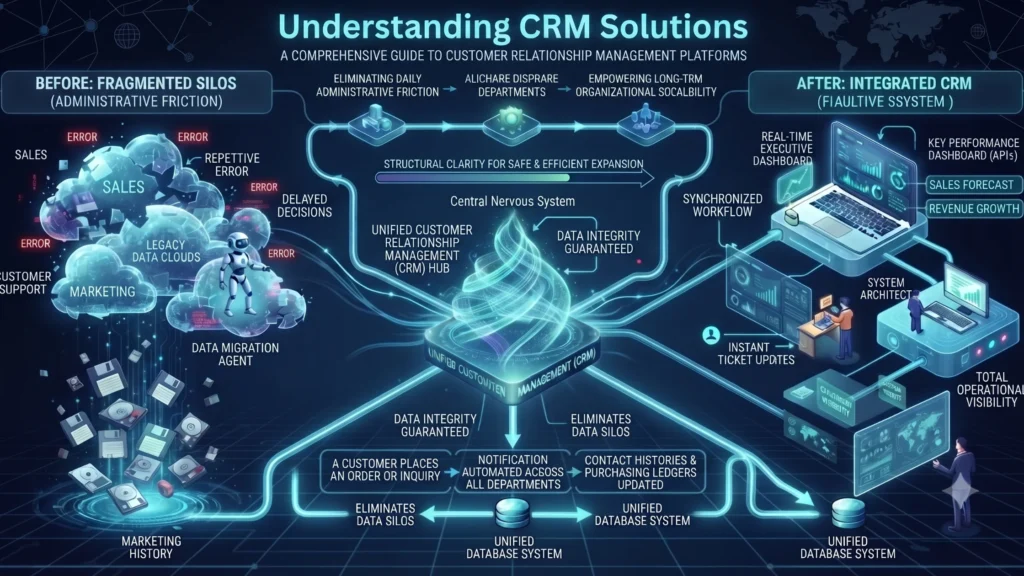
At its core, customer relationship management refers to specialized software that manages daily client activities seamlessly. Modern platforms combine sales pipelines, customer support tickets, and marketing history into one unified database system. Business management tools act as a central nervous system, ensuring smooth inter-departmental communication daily. These systems eliminate data silos so employees can collaborate without unnecessary friction or delays.
Beyond basic contact tracking, these platforms incorporate advanced analytics modules that aggregate company-wide metrics into actionable executive dashboards. This structural visibility allows organizations to forecast sales demands more accurately and allocate capital resources toward high-growth departments. Employees across every tier of the corporate hierarchy benefit from standardized operational protocols.
✅ How CRM Software Works
Traditional business software often operates in frustrating silos that cause repetitive human errors and delays. Centralized databases eliminate this daily friction by updating contact histories and purchasing ledgers instantly. When a customer places an order or submits an inquiry online, the platform automates notifications across all relevant departments.
This integrated architecture makes modern CRM Solutions completely indispensable for achieving long-term business agility. Businesses that rely on these synchronized workflows dramatically reduce their overall administrative processing times. Beneath the surface interface, these software frameworks rely on a robust relational database management system that guarantees data integrity across every single transaction.
✨ Common Customer Management Challenges Without CRM Solutions
Recognizing the hidden operational pitfalls and systemic inefficiencies of legacy workflows helps organizations deeply understand why manual tracking methods ultimately hold back scalable growth, suppress profit margins, and stifle inter-departmental collaboration. Additionally, addressing these vulnerabilities prevents unexpected operational failures that routinely damage customer trust and brand reputation in fast-moving industries.
✅ Lost Leads and Poor Follow-Ups
Disjointed software applications and heavy paperwork severely damage daily staff productivity across the enterprise. Employees waste countless hours copying data manually across separate, uncoordinated spreadsheets every week. Without proper digital coordination, workers get trapped in repetitive administrative tasks rather than strategic goals.
Implementing robust CRM Solutions automates these tedious workflows to save valuable company time. Streamlining these repetitive processes protects corporate revenue streams from costly human data entry mistakes. These administrative bottlenecks not only drain employee morale but also delay project delivery timelines, leading to client dissatisfaction and missed market opportunities.
✅ Scattered Customer Data and Communication
Communication breakdowns happen constantly because isolated legacy systems prevent clear real-time operational visibility. Deploying professional integrated software bridges these communication gaps smoothly across every single department.
- Single Source of Truth: Eliminates embarrassing fulfillment mistakes by aligning every business unit under shared metrics.
- Collaborative Decisions: Leaders can make choices without waiting for delayed cross-departmental reports.
- Supply Chain Synchronization: Prevents sales teams from promising dates that warehouse teams cannot support.
- Brand Credibility: Resolves internal friction and prevents hostile working environments where departments shift blame.
✨ Key Features of Modern CRM Solutions
Examining the extensive core capabilities and advanced technological architecture of enterprise software reveals how centralized design and automated intelligence elevate corporate performance across all metrics. Moreover, understanding these advanced features enables management teams to maximize return on investment upon full system deployment.
✅ Lead, Contact, and Sales Pipeline Management
Elite enterprise platforms feature powerful centralized operational dashboards designed for executive oversight. Business leaders can track pipeline velocity, lead scoring, and sales analytics in one single place. Effective CRM Solutions give decision-makers total enterprise clarity without complex data consolidation hurdles. Managing daily performance through one intuitive screen saves hours of administrative cross-referencing work.
This high level of centralization empowers managers to spot negative performance trends much faster. Modern executive dashboards aggregate complex financial ledgers, human resource logs, and customer relationship histories into clean, visual graphic representations. Rather than waiting for weekly meetings or manual department spreadsheets, directors utilizing comprehensive CRM Solutions can evaluate real-time organizational health with a single click.
✅ Automation, Reporting, and Customer Insights
Modern software platforms provide real-time data analytics to turn raw numbers into visual insights instantly. Automation handles routine operational tasks like email follow-ups, payment reminders, and lead reassignments. Advanced CRM Solutions minimize operational lag and accelerate overall organizational throughput seamlessly. Teams no longer wait weeks for month-end financial statements to evaluate business health.
Automated alerts notify management immediately when account engagement drops below critical safety thresholds. Operational speed is a major differentiator in today’s hyper-competitive global marketplace, making automated data processing an absolute necessity for modern enterprises. Real-time reporting features empower financial controllers and sales directors to monitor conversion fluctuations dynamically rather than performing retroactive post-mortems at the end of each fiscal quarter.
✨ How CRM Solutions Strengthen Customer Relationships
Leveraging advanced software architecture directly translates into maximized labor productivity, streamlined fulfillment cycles, minimized resource waste, and heavily reduced enterprise overhead expenses over time. Consequently, organizations experience accelerated revenue growth and significantly enhanced profit margins across every operational division.
✅ Personalized Customer Experiences
System automation lifts heavy administrative burdens to make employee productivity skyrocket across teams. Staff members equipped with CRM Solutions spend less time searching for files or correcting entry mistakes.
- Revenue Focus: Employees redirect their energy toward high-value tasks that directly generate revenue.
- Predefined Automation: Handles routine client onboarding and service ticket routing automatically.
- Enhanced Engagement: Stripping away administrative friction allows workers to experience renewed purpose in creative problem-solving.
- Retention Rates: Streamlined workflows accelerate project delivery timelines and maximize overall client retention.
✅ Faster Responses and Improved Customer Retention
Operational waste drains financial resources and narrows profit margins every single month. Advanced business tools quickly identify and eliminate these specific areas of financial waste. Modern CRM Solutions provide accurate forecasting data necessary for confident strategic decisions. Purchasing managers can order exact inventory quantities, avoiding costly storage fees and spoilage.
Data-driven resource allocation ensures every dollar spent contributes directly to sustainable business growth. Financial optimization relies heavily on precise visibility into inventory turnover ratios, vendor pricing trends, and labor expenditure allocations. Armed with predictive forecasting modules found in top-tier CRM Solutions, executive boards can model various economic scenarios before committing significant venture capital to new expansion projects.
✨ Choosing the Right CRM Solution
Navigating vendor options carefully ensures that your chosen software deployment matches long-term business goals, budgetary limitations, security compliance standards, and precise technical requirements. Furthermore, a structured vendor evaluation process minimizes unexpected expenses during the initial system integration phase.
✅ Essential Features Every Business Needs
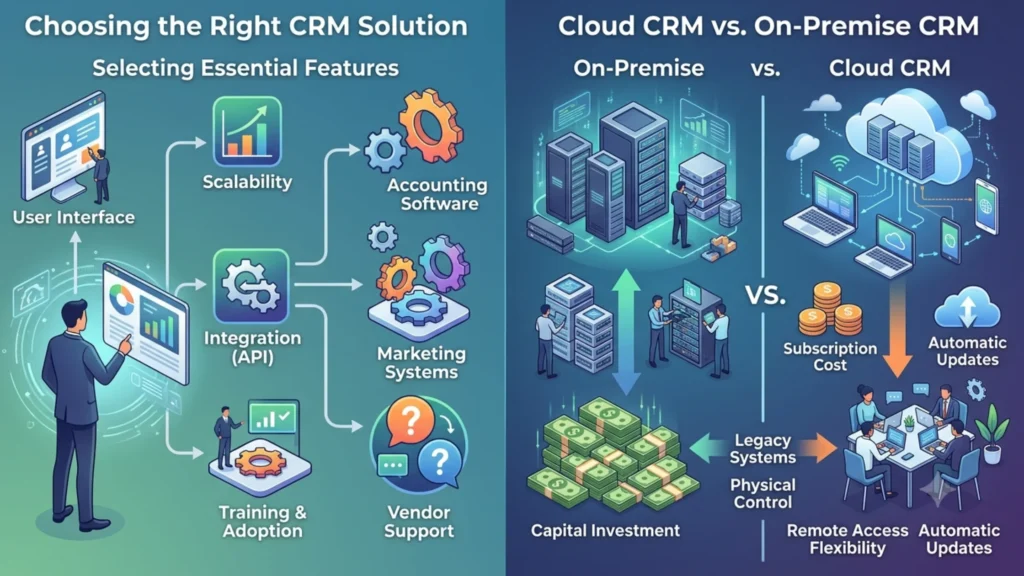
Selecting the right software platform requires careful evaluation of unique operational needs. Reliable ERP Solutions require intuitive user interfaces and robust horizontal scalability. Strong integration capabilities with existing tools and responsive vendor support ensure deployment success. The system must be easy to adopt so staff can transition without extensive training.
Choosing a modular design allows your tech stack to expand alongside transaction volumes. Implementing enterprise software is a multi-year investment, making it vital to select a vendor whose product roadmap aligns with your organization’s future growth targets. Decision-makers must evaluate whether prospective CRM Solutions offer robust API integrations to connect smoothly with legacy accounting platforms or specialized marketing execution systems.
✅ Cloud CRM vs. On-Premise CRM
Adopting CRM Solutions requires choosing between modern cloud subscriptions and traditional on-premise servers. The architectural debate between cloud hosting and local server infrastructure remains a primary consideration.
- On-Premise Capital Costs: Demands heavy upfront capital investment for local hardware and internal IT support teams.
- Physical Control: Traditional on-premise deployments give organizations absolute physical control over their hardware assets.
- Cloud Accessibility: Cloud-based options offer lower initial setup costs and remote access flexibility for distributed teams.
- Automatic Updates: Modern cloud subscriptions shift maintenance into predictable operational expenses with continuous updates.
Expert Advice: Always request a live demonstration tailored to your specific industry workflows before committing to any long-term contract for enterprise software.
✨ Future of CRM Solutions
Looking ahead at emerging technology trends demonstrates how artificial intelligence, machine learning algorithms, and next-generation cloud architectures will continue reshaping corporate management permanently. Additionally, staying informed about these innovations guarantees that modern enterprises maintain a sustainable competitive advantage well into the future.
✅ AI-Powered Intelligence and Smart Automation
Artificial intelligence is rapidly transforming how contemporary enterprise software functions on a daily basis. Cutting-edge CRM Solutions use predictive analytics to forecast future customer demand accurately. These smart features flag financial anomalies and optimize supply chain shipping routes automatically. Predictive maintenance alerts warn engineers about equipment failures before costly operational downtime occurs.
These intelligent updates give forward-thinking firms a major competitive advantage in the market. The integration of machine learning algorithms into enterprise platforms has revolutionized how businesses handle supply chain logistics and financial auditing. Next-generation CRM Solutions examine historical transaction patterns to predict market fluctuations, automatically adjusting procurement orders without manual oversight.
✅ Data-Driven Customer Engagement Trends
Hybrid and remote work models drive high market demand for mobile-friendly cloud software. Future platform iterations will feature deep mobile integration, voice-activated commands, and enhanced security.
- Digital Agility: Ensures your business stays resilient against sudden market volatility.
- Workstation Freedom: Corporate management is no longer bound to physical desktop computers.
- Responsive Applications: Enables field service agents and support supervisors to manage client interactions securely from anywhere.
- Global Collaboration: Connects international teams through unified mobile-ready database systems seamlessly.
Conclusion
Navigating the complexities of modern commerce requires much more than hard work because it demands smart, connected operational systems. Throughout this guide, we have explored how disjointed workflows drain profitability and how centralized platforms solve persistent organizational challenges. Investing in robust CRM Solutions is no longer a luxury reserved exclusively for massive multinational corporations.
Whether you run a small local business or a fast-scaling brand, modern CRM Solutions bring all core processes seamlessly under one unified roof. By streamlining daily operations, boosting cross-departmental coordination, eliminating manual data entry, and unlocking real-time insights, professional CRM Solutions provide the ultimate growth foundation.
Making this vital digital switch today actively positions your enterprise far ahead of aggressive market competitors, secures absolute operational transparency across every administrative department, empowers executives to make lightning-fast strategic adjustments based on live financial metrics, drastically reduces resource waste, and ensures seamless, highly profitable corporate execution for many successful years to come.
Reach out to TechnoComet Solutions today! 🚀💡📌
FAQs
What are CRM solutions, and how do they help?
They are integrated software suites that combine sales pipelines, support tickets, and marketing history into one database to eliminate silos and automate routine tasks.
How do I know if my business is ready for one?
If your team relies on isolated spreadsheets, faces frequent communication breakdowns, or wastes hours on manual data entry, your company is ready.
What is the difference between cloud and on-premise CRM solutions?
On-premise deployments require expensive local servers and maintenance teams. Cloud options offer lower initial costs, automatic updates, and secure remote access.
How do these CRM Solutions reduce operating costs?
By automating manual workflows and eliminating human errors, they save labor hours and provide exact forecasting to allocate resources wisely and avoid waste.
What key features should I look for?
Look for intuitive user interfaces, robust scalability, strong integration capabilities with existing tools, responsive vendor support, and role-based access controls.