















Introduction
Businesses are increasingly using data to understand trends, improve decisions, and identify future opportunities across every commercial sector. In today’s hyper-competitive digital economy, raw information serves as the core foundational bedrock for strategic corporate growth. Companies must harness data effectively to remain competitive across fast-moving markets while leveraging specialized frameworks like Machine Learning vs Predictive Analytics. Modern enterprises generate vast volumes of daily operational information from customer touchpoints, sales transactions, digital logs, and supply chain telemetry. Without advanced analytical tools, this data remains an underutilized asset that provides little to no strategic value for decision-makers.
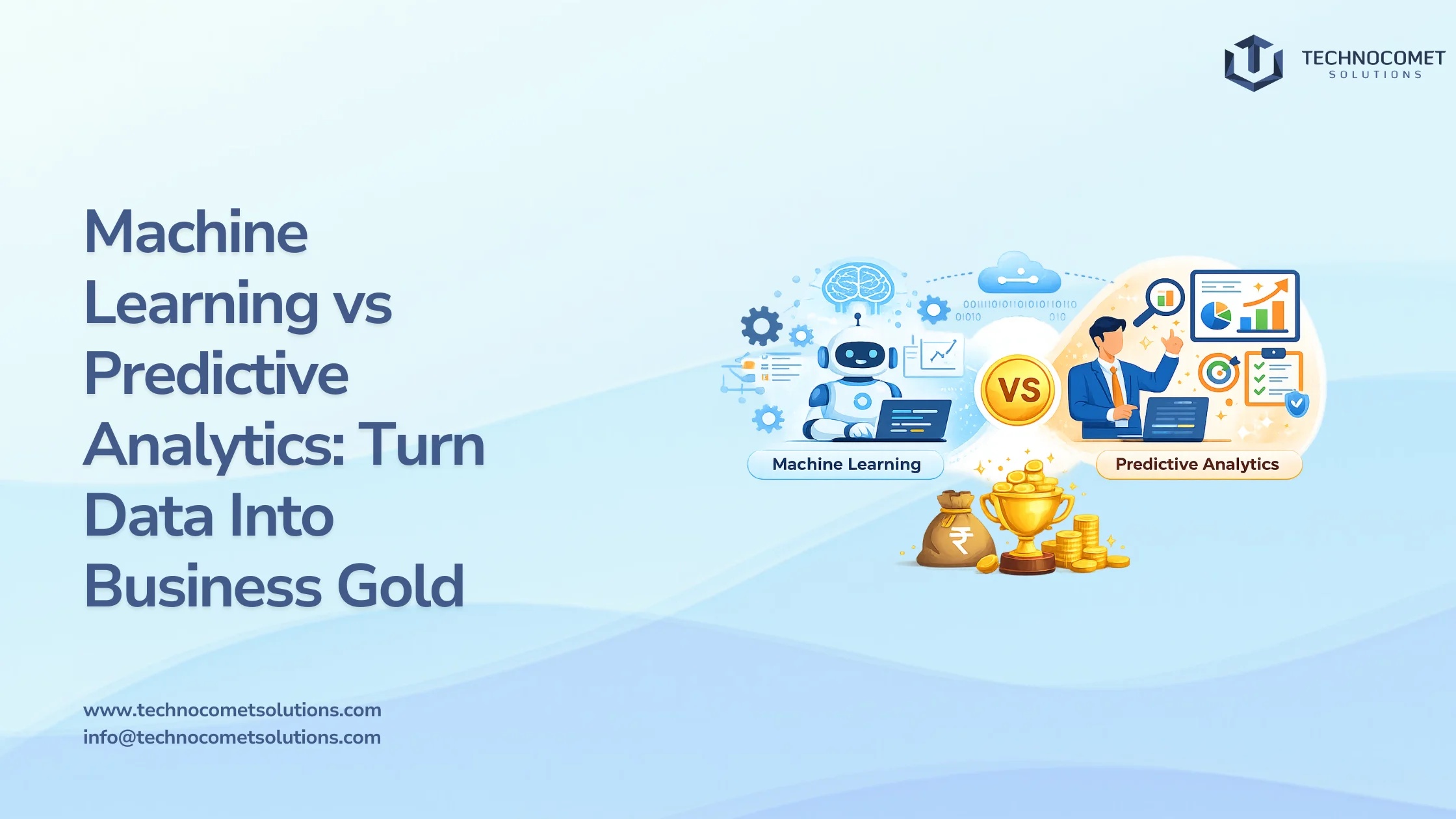
Machine learning and predictive analytics both turn data into insights, but they differ fundamentally in how they process information and support business decisions. While one relies on established statistical modeling and fixed historical parameters, the other leverages autonomous computational learning to adapt over time without human intervention. Understanding these underlying methodologies within Machine Learning vs Predictive Analytics changes how modern enterprises approach complex data systems. Traditional statistical methods require analysts to define explicit rules and equations to establish relationships between variables. In contrast, advanced computational algorithms ingest massive streaming datasets and automatically discover non-linear correlations that humans might easily overlook.
Let’s explore the key differences between Machine Learning vs Predictive Analytics and how businesses can use both effectively to drive sustainable growth. Navigating these advanced digital frameworks allows organizations to optimize their internal operations, reduce overhead costs, and maximize long-term profitability. Discover how TechnoComet Solutions helps businesses implement these transformative strategies using Machine Learning vs Predictive Analytics.
✨ Understand Machine Learning & Predictive Analytics
Understanding Machine Learning vs Predictive Analytics is essential for building a modern, resilient data strategy in today’s fast-paced corporate environment. Organizations frequently confuse these two distinct concepts, treating them as interchangeable terms when evaluating Machine Learning vs Predictive Analytics for enterprise deployment. However, they possess entirely different operational mechanics, mathematical foundations, and real-world use cases. Evaluating Machine Learning vs Predictive Analytics helps executive leaders deploy the right technical tools for specific business problems rather than applying a generalized, inefficient approach.
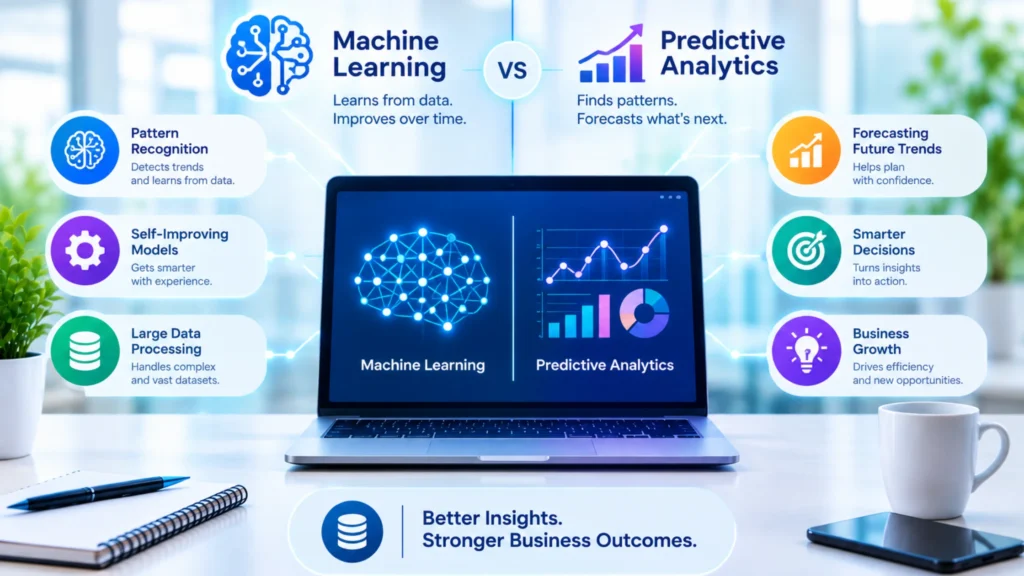
✅ Explore how machine learning learns from data to identify patterns and improve predictions over time
Explore how machine learning learns from data to identify patterns and improve predictions over time through Machine Learning vs Predictive Analytics by removing traditional programming barriers. By leveraging advanced computational frameworks within Machine Learning vs Predictive Analytics, organizations can unlock automated intelligence across multiple operational layers.
- Autonomous Learning: Systems analyze massive data inputs without requiring rigid, hard-coded rules for every operational scenario during Machine Learning vs Predictive Analytics adoption.
- Pattern Recognition: Advanced algorithms scan vast, multi-dimensional datasets to detect hidden correlations and complex behavioral trends automatically.
- Continuous Evolution: Models refine their predictive accuracy dynamically as fresh, real-time data flows into the enterprise analytical ecosystem.
- Complex Adaptability: The framework effortlessly handles unstructured information like natural language text, digital images, and streaming audio with high precision.
- Strategic Value: Applying Machine Learning vs Predictive Analytics in highly dynamic commercial settings gives companies an adaptive, future-proof edge.
✅ Understand how predictive analytics uses historical and current data to forecast potential future outcomes
Understand how predictive analytics uses historical and current data to forecast potential future outcomes through structured modeling techniques via Machine Learning vs Predictive Analytics. This methodology provides reliable projections that help organizations plan upcoming financial cycles with absolute confidence using Machine Learning vs Predictive Analytics.
- Historical Grounding: Analytics relies heavily on established historical datasets, regression analysis, and structured statistical models to project trends.
- Structured Modeling: Algorithms apply fixed mathematical rules and parameters to project upcoming business outcomes and performance metrics.
- Proactive Planning: Leaders use these structured forecasts to anticipate customer needs, inventory shifts, and financial risks well in advance.
- Transparency: The analytical outputs remain highly explainable, making it much easier for stakeholders to audit baseline assumptions and calculations.
- Core Focus: Examining Machine Learning vs Predictive Analytics highlights how predictive models excel at structured forecasting tasks within stable environments.
📌 TechnoComet Solutions helps businesses identify the right AI and data-driven approach based on their goals and operational needs.
✨ Improve Business Forecasting
Improving organizational forecasting requires robust analytical frameworks that eliminate guesswork and provide clear visibility into future market conditions. Enterprises can no longer rely on static spreadsheets or outdated historical averages to plan upcoming fiscal quarters. Analyzing Machine Learning vs Predictive Analytics reveals superior forecasting capabilities that transform how supply chains, sales pipelines, and customer service departments operate. Companies leveraging Machine Learning vs Predictive Analytics mitigate market uncertainty effectively and optimize resource allocation across all departments. Let us examine closely how these advanced methodologies optimize future projections and drive commercial success.
✅ Use historical data and predictive models to anticipate demand, sales, customer behaviour, and operational trends
Use historical data and predictive models to anticipate demand, sales, customer behaviour, and operational trends across various departments through Machine Learning vs Predictive Analytics. By examining past performance metrics, companies can prepare for seasonal shifts and optimize resource deployment via Machine Learning vs Predictive Analytics.
- Demand Anticipation: Supply chain teams utilize forecasting models to optimize inventory levels, reduce warehousing costs, and prevent costly stockouts.
- Sales Projections: Historical sales data feeds into sophisticated models that predict quarterly revenue with significantly greater accuracy and reliability.
- Behavior Tracking: Retailers and e-commerce platforms analyze customer purchase histories to anticipate seasonal shopping shifts and personal preferences.
- Operational Clarity: Structured models highlight potential bottlenecks and logistical failures before they disrupt daily enterprise business workflows.
- Strategic Alignment: Evaluating Machine Learning vs Predictive Analytics ensures internal teams pick reliable forecasting structures for complex projects.
✅ Apply machine learning models to refine predictions as new data becomes available
Apply machine learning models to refine predictions as new data becomes available to maintain peak accuracy in real time through Machine Learning vs Predictive Analytics. Continuous ingestion of streaming data eliminates the lag associated with traditional periodic reporting mechanisms via Machine Learning vs Predictive Analytics.
- Real-Time Updates: Algorithms ingest live data feeds continuously to update corporate forecasts instantly without manual analyst intervention.
- Error Reduction: Automated feedback loops analyze past prediction errors to adjust upcoming algorithmic weights and improve future accuracy.
- Dynamic Rescoring: Customer churn and credit risk scores adjust dynamically as ongoing user interactions and behaviors change.
- Scalable Precision: Advanced models handle multi-variable inputs effortlessly without requiring constant manual system recalibration.
- Advanced Insight: Mastering Machine Learning vs Predictive Analytics transforms static reports into self-improving corporate intelligence assets.
💡 Tip: Use clean, relevant, and well-structured data to improve the reliability of business forecasting models.
✨ Make Smarter Data-Driven Decisions
Decision-making defines organizational success or failure in every modern industry. Corporate leaders need reliable intelligence to steer high-stakes strategy, manage risk, and allocate capital effectively. Comparing Machine Learning vs Predictive Analytics shows how raw data converts into strategic gold for executive teams. Implementing Machine Learning vs Predictive Analytics empowers cross-functional teams to make confident, evidence-based choices. Let us explore how data-driven insights elevate leadership choices and eliminate costly administrative guesswork.
✅ Turn large volumes of business data into actionable insights for strategic planning
Turn large volumes of business data into actionable insights for strategic planning by centralizing disparate corporate databases through Machine Learning vs Predictive Analytics. Unified repositories give executives clear, organization-wide visibility to guide long-term growth and expansion roadmaps using Machine Learning vs Predictive Analytics.
- Data Aggregation: Centralize disparate corporate databases into unified analytical repositories for clear, organization-wide visibility.
- Actionable Intelligence: Convert raw metrics into clear, prioritized directives that executive management teams can execute immediately.
- Risk Mitigation: Identify emerging financial vulnerabilities and compliance risks early through comprehensive, automated data scanning.
- Resource Optimization: Allocate capital and personnel based on data-backed performance indicators rather than subjective intuition.
- Enterprise Growth: Strategic assessments of Machine Learning vs Predictive Analytics guide long-term digital investments and expansion roadmaps.
✅ Support teams in identifying opportunities, risks, and patterns that may not be immediately visible
Support teams in identifying opportunities, risks, and patterns that may not be immediately visible through advanced anomaly detection via Machine Learning vs Predictive Analytics. Equipping non-technical staff with intuitive tools fosters a culture of proactive problem-solving across departments using Machine Learning vs Predictive Analytics.
- Hidden Correlation: Advanced models uncover subtle, cross-departmental patterns that remain completely invisible to human analysts.
- Market Opportunity: Spot emerging consumer niches and micro-trends before competitors launch competing commercial offerings.
- Anomaly Detection: Instantly flag unusual transactional behavior across financial ledgers to prevent internal and external fraud.
- Empowered Staff: Equip non-technical teams with intuitive, self-service dashboards driven by underlying predictive frameworks.
- Competitive Edge: Understanding Machine Learning vs Predictive Analytics ensures companies seize unseen market opportunities proactively.
📌 Partner with TechnoComet Solutions to build intelligent data solutions that help your business turn complex information into actionable insights.
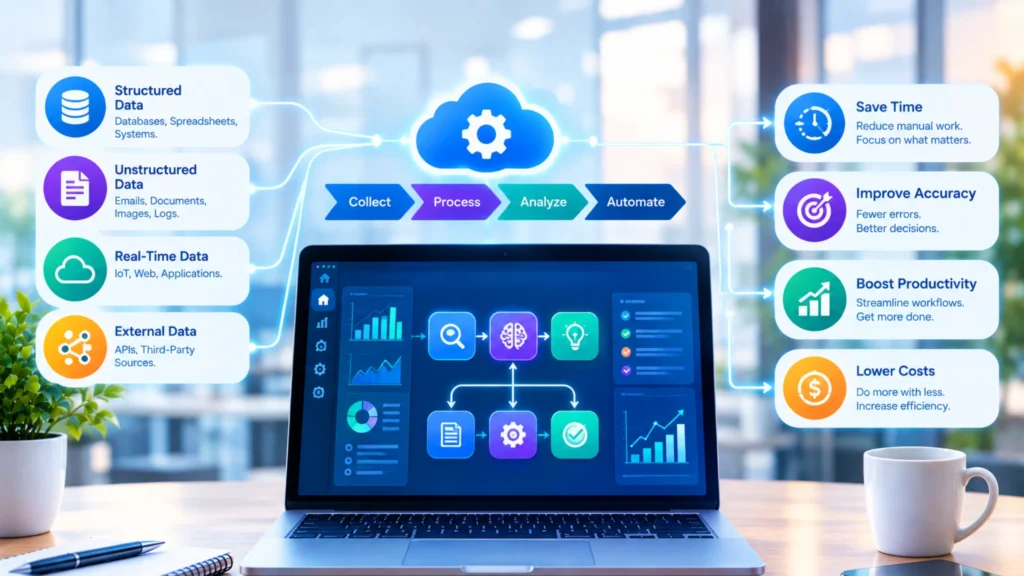
✨ Automate Insights & Business Processes
Automation drives modern enterprise scalability and operational resilience. Manual insight generation consumes valuable staff hours that could be dedicated to core revenue-generating activities. Exploring Machine Learning vs Predictive Analytics uncovers massive efficiency gains across administrative and technical departments. Deploying Machine Learning vs Predictive Analytics standardizes repetitive operational tasks while eliminating human error. Let us look at how intelligent automation redefines enterprise workflows and accelerates overall business velocity.
✅ Use machine learning to automate pattern recognition, recommendations, and data-driven predictions
Use machine learning to automate pattern recognition, recommendations, and data-driven predictions across high-volume workflows via Machine Learning vs Predictive Analytics. Streamlining routine sorting and personalization tasks frees up valuable human capital for creative strategic endeavors using Machine Learning vs Predictive Analytics.
- Automated Tagging: Classify incoming customer service tickets, emails, and digital documents instantly without human intervention.
- Personalized Engines: Build dynamic product recommendation systems tailored precisely to individual user browsing habits and history.
- Streamlined Operations: Eliminate tedious manual data sorting routines across HR, finance, and marketing enterprise departments.
- Instant Responses: Deploy smart conversational chatbots that resolve complex user queries instantly using natural language processing.
- Workflow Velocity: Assessing Machine Learning vs Predictive Analytics highlights how intelligent automation accelerates task execution.
✅ Apply predictive analytics to support automated decision-making across selected business processes
Apply predictive analytics to support automated decision-making across selected business processes like vetting and risk evaluation via Machine Learning vs Predictive Analytics. Standardizing approval criteria against historical parameters ensures consistent operational execution and rapid response times with Machine Learning vs Predictive Analytics.
- Automated Vetting: Evaluate commercial insurance claims and credit applications against established historical risk parameters automatically.
- Triggered Actions: Set automated operational alerts when predictive thresholds indicate potential supply chain or logistical delays.
- Rule-Based Logic: Execute routine business approvals based on stable, statistically validated forecast models and parameters.
- Process Consistency: Reduce human error in recurring operational decisions through standardized, repeatable analytical metrics.
- Operational Harmony: Integrating Machine Learning vs Predictive Analytics streamlines enterprise-wide decision pathways seamlessly.
💡 Tip: Start with clearly defined business use cases where automated predictions can support measurable operational improvements.
✨ Choose the Right Approach for Your Business
Selecting the optimal analytical model dictates project ROI, system performance, and long-term technical viability. Every enterprise faces unique operational constraints, budget limitations, and technical requirements. Analyzing Machine Learning vs Predictive Analytics clarifies implementation pathways for IT directors and project managers. Evaluating Machine Learning vs Predictive Analytics prevents costly architectural mistakes and ensures optimal resource deployment. Let us determine how to choose the right strategy for your specific enterprise environment.
✅ Select predictive analytics when forecasting specific business outcomes is the primary objective
Select predictive analytics when forecasting specific business outcomes is the primary objective and historical data is robust using Machine Learning vs Predictive Analytics. This approach delivers rapid deployment and high explainability for internal stakeholders and regulatory reporting via Machine Learning vs Predictive Analytics.
- Clear Objectives: Choose predictive models when you have well-defined business questions and structured historical datasets.
- Rapid Deployment: Implement statistical forecasting quickly with limited computational overhead and shorter engineering timelines.
- Stable Environments: Rely on analytics when underlying business processes remain relatively stable and predictable over time.
- Transparent Results: Utilize models that offer high explainability and clear auditing for regulatory and stakeholder reporting.
- Focused Solutions: Reviewing Machine Learning vs Predictive Analytics ensures you deploy simple, effective tools for straightforward tasks.
✅ Consider machine learning when applications need to learn from data and adapt as patterns change
Consider machine learning when applications need to learn from data and adapt as patterns change in unstructured environments via Machine Learning vs Predictive Analytics. Investing in robust computational architecture prepares your enterprise for advanced automation and real-time classification demands using Machine Learning vs Predictive Analytics.
- Complex Data: Opt for algorithms when dealing with high-dimensional, unstructured, or fast-changing digital datasets.
- Continuous Adaptation: Deploy adaptive models that automatically recalibrate as market conditions and user behaviors shift.
- Deep Computational Needs: Invest in robust infrastructure when scaling complex neural networks or multi-layered ensemble methods.
- Advanced Automation: Use systems for real-time classification, clustering, and predictive generation tasks across applications.
- Future-Proofing: Applying Machine Learning vs Predictive Analytics correctly future-proofs your enterprise tech stack for years.
📌 TechnoComet Solutions can help you choose and implement machine learning or predictive analytics solutions aligned with your business objectives.
Conclusion
Transforming raw enterprise data into valuable business gold requires a deliberate technical strategy, robust tooling, and expert execution. Evaluating Machine Learning vs Predictive Analytics allows organizations to deploy appropriate data frameworks for sustainable, long-term growth across competitive markets. Embracing modern data intelligence elevates decision-making across all corporate departments, from marketing and sales to logistics and executive leadership.
Organizations that successfully integrate these advanced digital methodologies unlock unprecedented operational efficiency and maintain a decisive advantage over industry rivals.
Navigating the nuances of Machine Learning vs Predictive Analytics ensures that resources are allocated toward solutions that deliver measurable financial returns and long-term scalability. Continuous adaptation and proactive forecasting will remain the primary drivers of commercial success in the modern digital economy.
Partnering with experienced technology specialists ensures seamless architecture design, efficient implementation, and high return on investment for your enterprise data initiatives. TechnoComet Solutions provides the specialized expertise required to bridge the gap between complex algorithms and practical business value.
Reach out to TechnoComet Solutions today! 🚀💡📌
FAQs
What is the main difference in Machine Learning vs Predictive Analytics?
Predictive analytics uses fixed statistical models and historical data to forecast outcomes, while machine learning algorithms adapt and learn autonomously from new data without explicit reprogramming.
Can businesses use both components of Machine Learning vs Predictive Analytics together?
Yes, machine learning is frequently integrated as an advanced engine within predictive analytics workflows to enhance forecasting precision and adaptability.
When should a company choose predictive analytics over machine learning?
Choose predictive analytics when working with structured historical data, stable business processes, and a need for highly transparent, explainable results.
What types of data are best suited for machine learning models?
Machine learning excels at processing large-scale, complex, and unstructured datasets, including customer sentiment texts, streaming telemetry, and image files.
How does the IT Company help with data-driven projects?
IT Company provides expert guidance, custom architecture design, and end-to-end implementation support tailored to your unique business goals.